
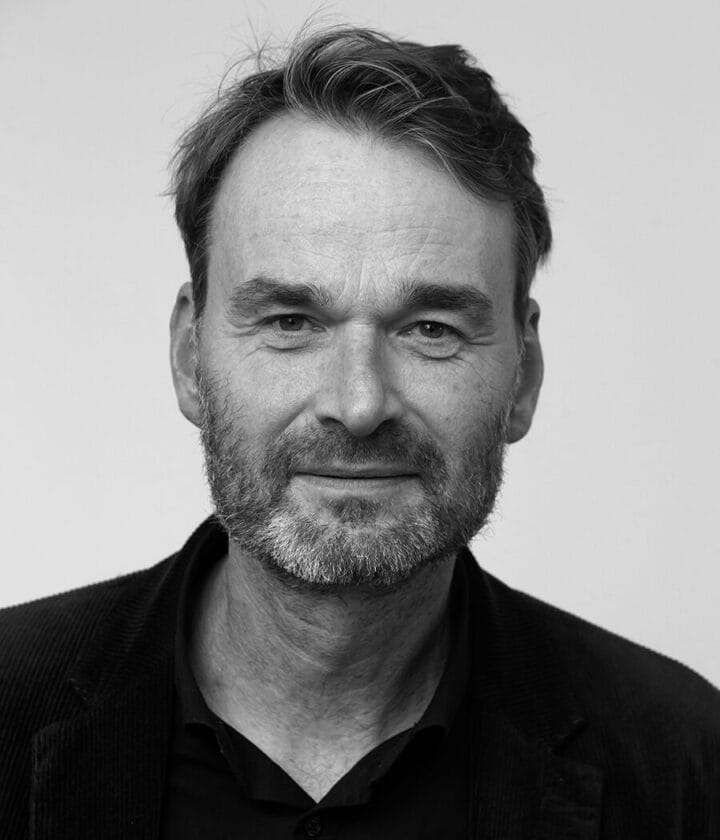
Carsten Ruhl is Professor of Architectural History at Goethe University Frankfurt, a founding member of the Center for Critical Studies in Architecture (CCSA) and one of two Directors of the DFG research cluster Organizing Architectures. His work focuses on the post-18th-century history and theory of architecture. He edited Mythos Monument. Urbane Strategien in Architektur und Kunst seit 1945, Bielefeld 2011; co-edited Architektur ausstellen. Zur mobilen Anordnung des Immobilen, Berlin 2015; and Death and Life of the Total Work of Art. Henry van de Velde and the Legacy of a Modern Concept, Berlin 2015. In 2013, he published his habilitation thesis “Magisches Denken – Monumentale Form. Aldo Rossi und die Architektur des Bildes”, Tübingen/Berlin 2013. More recent books include: Kracauer’s Architecture. The Ornamental Nature of the New Capitalist Order, CCSA Topics, Weimar 2022, and Bauhaus Clouds. Challenges to the Nebula of Architectural Histories and Archives, CCSA Topics, Weimar 2025 (with Daniela Ortiz dos Santos and Oliver Elser).
E-Mail: ruhl@kunst.uni-frankfurt.de
Research interest
In his recent research project, “Depthless Spaces. A Different Theory of Architecture”, Carsten proposes to view architectures as surface phenomena rather than spatial entities. On this basis, a critical reflection on architectural constructions is to be made possible, which, in addition to historical aspects, also takes into account developments in media and cultural studies as well as sociology. After all, what is described as an architectural surface depends to a large extent on developments in media technology. In this context, the terms ‘surface reality’ and ‘surface regime’ serve to emancipate architectural theory from space as the supposed core of architecture. Instead, Carsten emphasizes that the notion of “depthless space” (Jameson) expresses a paradox in architectural theory that is only superficially reflected and mostly misunderstood as a problematic negation of architectural space. By asking instead how architecture organizes surface regimes, the project is directly linked to the overall theme of the RTG.
