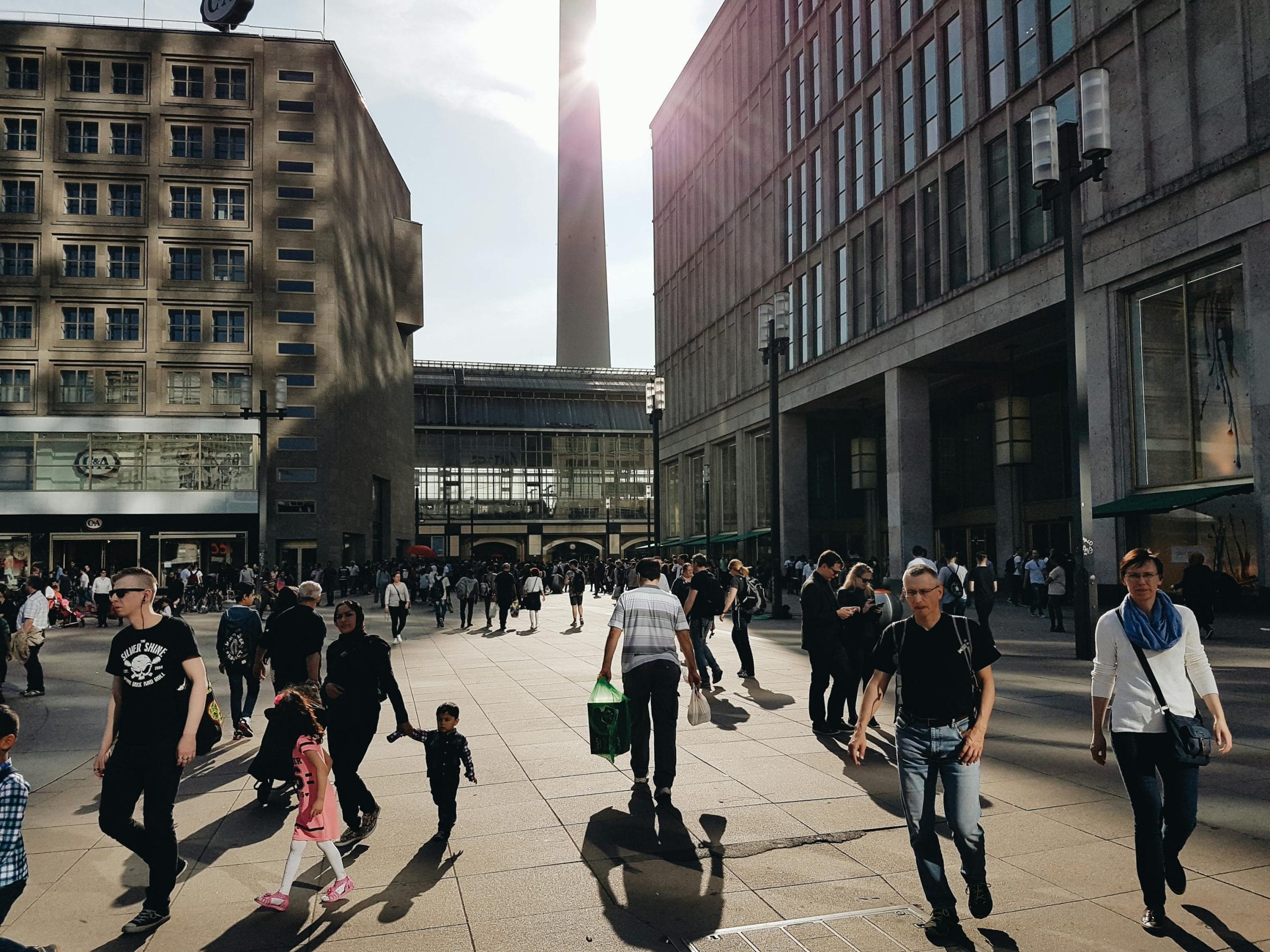
In an increasingly urban world susceptible to population migration, there is a growing interest in the effects of spatial organization on political behavior. A city’s public spaces are places where individuals from different backgrounds may meet, such as streets, squares, parks, sidewalks. In this research we investigate the relation between electoral behavior and co-presence of distinct ethnic groups in public spaces in the city of Berlin. Previous research has shown that the configuration of space creates patterns of movement and, consequently, of co-presence. When moving through the city, individuals are aware of the people around them. Contact theory has highlighted the potential of observing otherness to increase tolerance, while geographers point out that spatial proximity can reinforce prejudices. More recently, some studies have investigated how specific types of urban fabric affect electoral choices and voter turnout, demonstrating that there is room for further research on the effects of spatial configuration on political behaviour.
What we observe as we move through public spaces helps shape our comprehension of the world around us. Voting is one expression of this worldview, which is also manifested in its absence. Using the methodological framework of Space Syntax, we will analyze where Berlin’s network of public spaces contributes to or hinders encounters. This spatial analysis will be cross-referenced with voting and abstention results in German national elections since 2009. Data will be calibrated by other factors that may influence electoral behavior, such as demographic and socioeconomic information. The goal is to contribute to an understanding of the political resonances of spatial configuration in a diverse society.