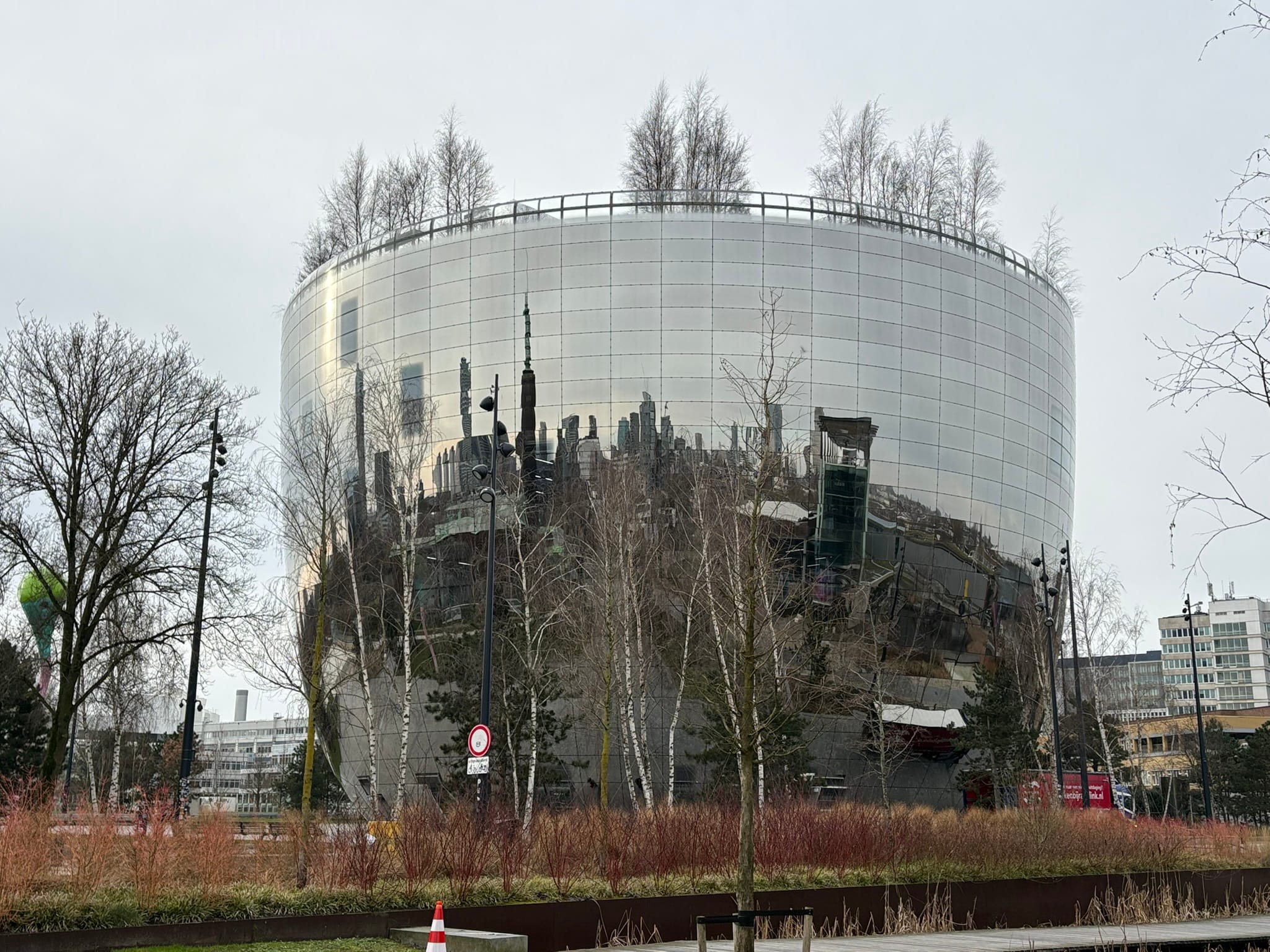
During our visit to Rotterdam, some of us were unexpectedly struck by the Depot Boijmans Van Beuningen, standing opposite Het Nieuwe Instituut, which we had actually come to see. “Unexpectedly” because it is very much a piece of wow‑architecture: a mirrored bowl‑shaped building with trees on the roof and a publicly accessible art depot—everything seemingly on the surface. But that surface turned out to be the point. Arriving from the main station, you never really see Rotterdam as a whole; the route is a sequence of fragments—isolated buildings and bits of urban fabric. At the Depot, however, the city suddenly appears as a single image reflected in its façade. The mirror cladding, composed of many panels, produces a collage‑like panorama—reminiscent of David Hockney’s pictorial collages—where the overall image is split into sheets with only slight offsets and overlaps to each other. The panel that contains your own reflection always appears central, as it is the only one perpendicular to your line of sight. You can see minute details of your own face, and your gaze then quickly travels out into the vast reflected space around you. This effect simultaneously opens up the surrounding space and places you at its centre, while maintaining a striking difference in scale—immersing you in a spatial experience of the whole city. The slightly tinted surfaces add a painterly quality, so that you suddenly find yourself inside a living, dynamic picture.
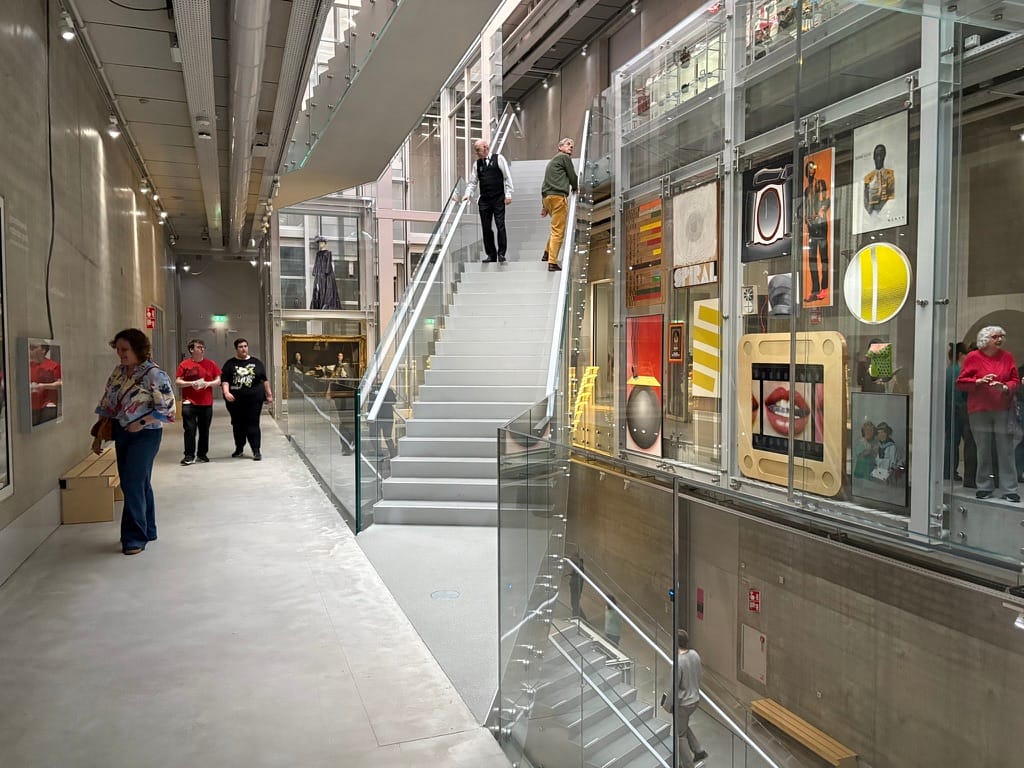
For me, this first impression was deepened by what followed. Het Nieuwe Instituut and its exhibitions are intensely focused on intermedial experience, where everything—objects, discourses, digital elements—is placed on the same imaginative perceptual surface. It can feel, at moments, like an outdated sensibility from the golden age of media art and its utopian promises, were it not for the fact that the Instituut remains one of the key sites where such practices are still being developed. The Instituut’s architecture itself manifests these principles: a deliberate collage of materials and elements, assembled from functionally and aesthetically distinct parts, with almost nothing concealed. Infrastructures and maintenance systems appear as part of the display, sometimes indistinguishable from the exhibited art works.
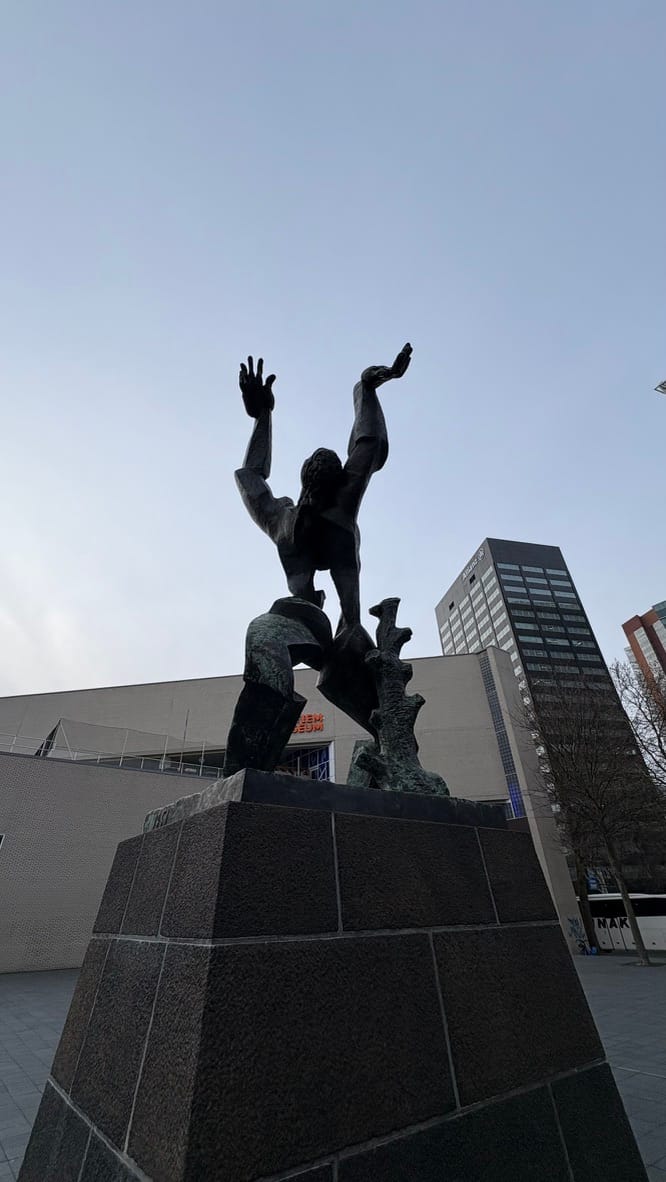
This gliding along a complex surface, where meanings and discourses mingle with objects and greenery, becomes a particularly apt way of accessing Rotterdam. As you walk through the city, you encounter a collage of disparate elements—as if it were built according to a blueprint of motley shipping containers stacked in shifting constellations. “I feel as if I were in many American cities at once,” a colleague from the US remarked to me. That is true, but there is also something else at play. One of Rotterdam’s key symbols is Ossip Zadkine’s sculpture The Destroyed City (1951), an image of a torn, collaged body—at once a human figure and the bombed-out city of 1940. The post‑cubist body is wounded, ripped open, full of hollows where parts should be, yet it still holds together as a kind of collaged unity.
This ever‑reassembled surface of the city collapses into the operative surface of its port capitalism—containers and other modules, including architecture, perpetually re‑stacked for the smooth flow of goods—and the imaginal surface of a neoliberal speculative economy, where everything is laid out on the plane of exchange value and financial derivative instruments.
In this sequence, the interior of Depot Boijmans Van Beuningen reads as a depot of art in the post‑internet era: a storage landscape where visitors move smoothly along ramps and walkways between levels, accessing works that appear as pure commodities in a port warehouse, ready for shipment. The immersive reflected cityscape on the Depot’s façade delivers this Rotterdam urban imaginary in a single blow—before you have even experienced it in all its other parts and facets.
Nikolay Smirnov is a geographer, curator, and art theorist, working with geographical imaginations, spatial practices, and representations of space in art and humanities.