
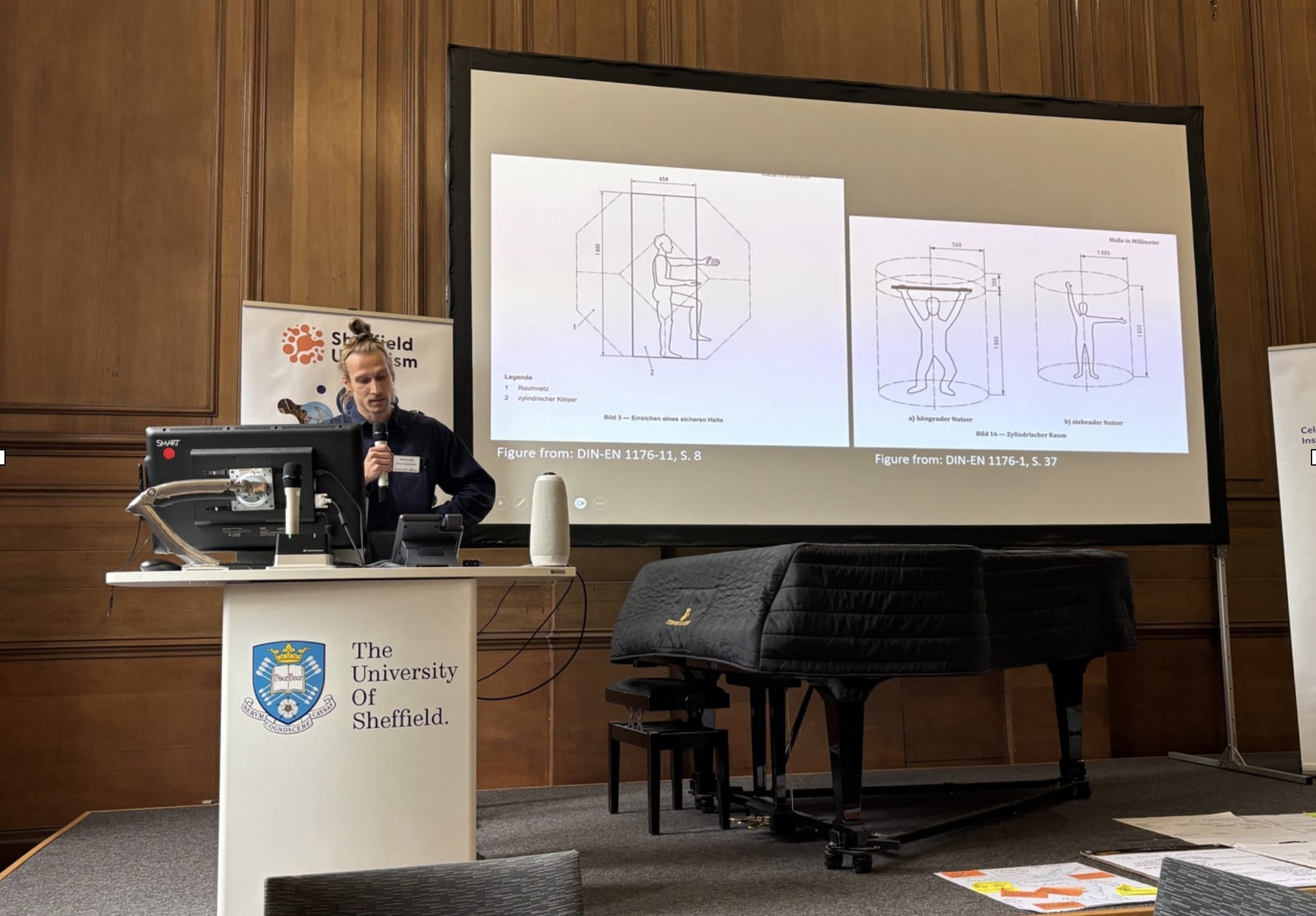
Talk by Dominik Laute at Emerging Urban Inequalities Conference, Urban Institute, University of Sheffield
Playgrounds are crucial sites in public urban spaces where play, but also childhood, takes place. They stand in contrast to a surrounding urban environment, which is perceived as unsafe and therefore inappropriate for children. Playgrounds thus become substantial places of negotiation in the production of urban spaces by and for children. A growing body of research has critically examined playgrounds as places where childhoods (subjectivities, bodies, (power)-relations etc.) are constituted. Building on and expanding this work, the thematic complex of my presentation takes a closer look at the architectures of playgrounds and the underlying power relations embedded within their material co-constitution of play. Based on architectural-production specific material assemblages unfold that (spatially) organise play and movement. Playstructures such as slides or swings territorialise children’s play and organise bodies along prestructured patterns of movement. The often rigid and closed materiality of playgrounds, emerging from adult-centered processes of architectural-production, encloses possibilities of children’s playful architectural-production taking place. This presentation addresses the field of tension between institutionalized architectural-production for children and resistant, informal and creative forms of Emerging Urban Inequalities Conference 2025 architectural-production by children, being located at the interface of geography, architecture and urban planning. Drawing on participatory methods (such as play-along and mappings), as well as interviews and document analysis, I explore the following questions:
● How are architectural-production and the positionality of children connected through the materiality of playgrounds?
● How do architectural-production and knowledge-production (spatial knowledge transformational knowledge) intersect in this context?
● How does the architectural-production of playgrounds shape children’s relation and approach towards their ecologies?
By June, I aim to present initial empirical insights into the spatial logics and operational mechanisms of institutionalized architectural-production of playgrounds. I will also present first insights about how children resist, subvert, critique and transform these predominant spatial strategies of adultist (re)production in different places.
26-27 June 2025
Urban Institute, University of Sheffield