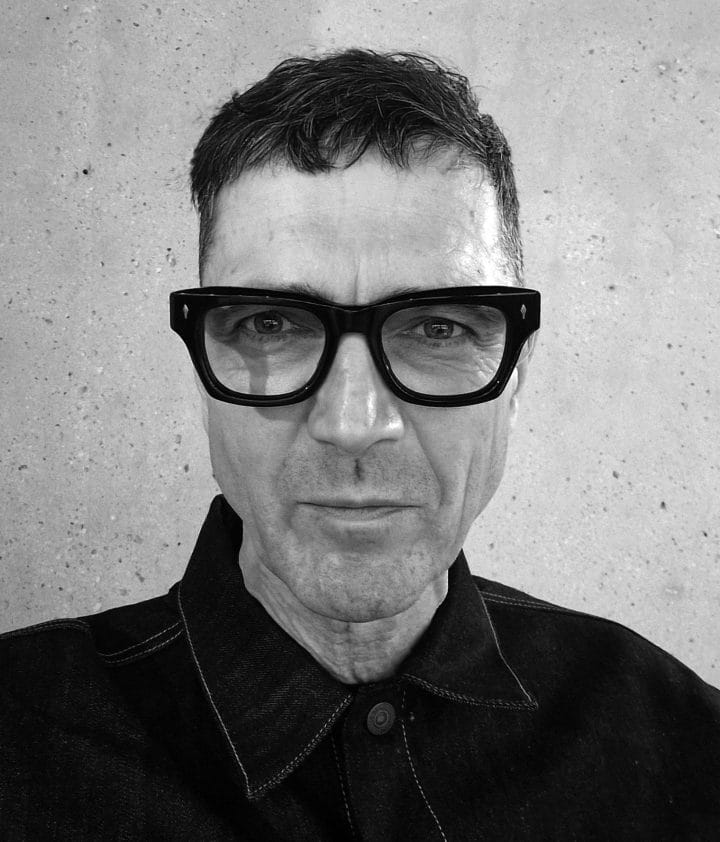
Michel Müller is an architect who lives and works in Darmstadt. In 1994, he received his degree in architecture with honors from the Technical University of Darmstadt. He has been working as a freelance architect since 1994. From 1996 to 2001, he served as a research assistant at the Institute for Industrialized Construction within the Faculty of Architecture at the Technical University of Darmstadt. From 1998 to 2001, he headed the institute there and worked on the ZIT research project “Virtuelle Experimentierfelder für energieeffiziente Architektur“.
In 2004, he was awarded a doctorate from the Technical University of Darmstadt for his thesis on “Autopoietische Raumsysteme – Nachhaltige Planungsstrategien anpassungsfähiger Architektur”.
In 2004, he taught as a visiting professor at the Institute for Scenography at the Karlsruhe University of Arts and Design. From 2005 to 2010, he was a professor of integrated planning methodology at the Stuttgart State Academy of Art and Design.
Since 2010, he has been a professor of artistic and experimental design at the Cologne University of Applied Sciences. Since 2011, he has served as an expert reviewer for international research projects in Southeast Asia on behalf of the German Academic Exchange Service (DAAD) in Bonn. His work includes the power plant at the Technical University of Darmstadt; two stations of the Wuppertal Suspension Railway; the Bockenheimer Depot Theater in collaboration with William Forsythe; the cockpit for an Airbus A340; the multifunctional Hall 603QM at the Technical University of Darmstadt; Cybermohalla Hub, a hybrid cultural institution in Delhi, India; the Art Sonje Center Project in Seoul; Fliegendes Künstlerzimmer; and the O16 shelter for the homeless in Frankfurt am Main. His current projects include the studio building “The Land” in Chiang Mai in collaboration with Rirkrit Tiravanija, the “House for Arguments and Stories” at the Shanghai Biennial, and the “e-flux building” in New York.
His exhibition architectures include “Making Things Public” in collaboration with Bruno Latour at the ZKM in Karlsruhe; “Frequenzen-HZ” at the Schirn Kunsthalle in Frankfurt am Main; a music pavilion at the Serralves Museum in Porto; the installation “Tower with Highway” in collaboration with Thomas Bayrle for the Museum of Modern Art in Frankfurt am Main; the installation “Node House” in collaboration with Raqs Media Collective. His works have been shown in various exhibitions, including “Can Buildings Curate” (AA School in London and the Storefront Gallery in New York); “Horn Please” (Kunstmuseum Bern, Switzerland, 2007); “On Cities” (Arkitekturmuseum, Stockholm, 2007); “The Rest of Now,” Manifesta 7 (Bolzano, Italy, 2008); “Do We Dream Under the Same Sky” (Art Basel, Switzerland, 2015); “Do We Dream Under the Same Sky” (Chicago Architecture Biennial, 2015); “Do We Dream Under the Same Sky” (ARoS Triennial, Aarhus, Denmark, 2017); “Do We Dream Under the Same Sky” (Seoul Biennale of Architecture and Urbanism, Seoul, 2017), “Do We Dream Under the Same Sky” (Luma Foundation, Luma Days, Arles, France, 2018), Open Space at the Crespo House, Crespo Foundation, Frankfurt am Main 2022–2025, and currently the two architectural projects “Besinnen – Bewahren – Beleben“, the conversion and revitalization of the synagogue and rabbi’s house complex in Schlüchtern into a new cultural and event venue, as well as the conversion and revitalization of the rabbi’s house in Gelnhausen into a place of remembrance.
Michel Müller