
Our Lab explores digital games that enable players to build cities. City builder video games can take them to past, present and future settings, being more or less closely linked to the material and social realities we experience outside the digital realm. We are investigating the complex relationships between game mechanics and aesthetics on the one side and the urban imaginaries standing behind games and practices of players on the other. In doing so, we aim to better understand how city building video games reflect urban realities and how players digitally materialize their ideas and phantasies of built environments in these games. Through the interdisciplinary lens of architecture history, dramaturgy, geography, media studies, planning studies, urban studies and sociology we work on innovative experiments, publications and interactive forms of presenting our research to a wider public.
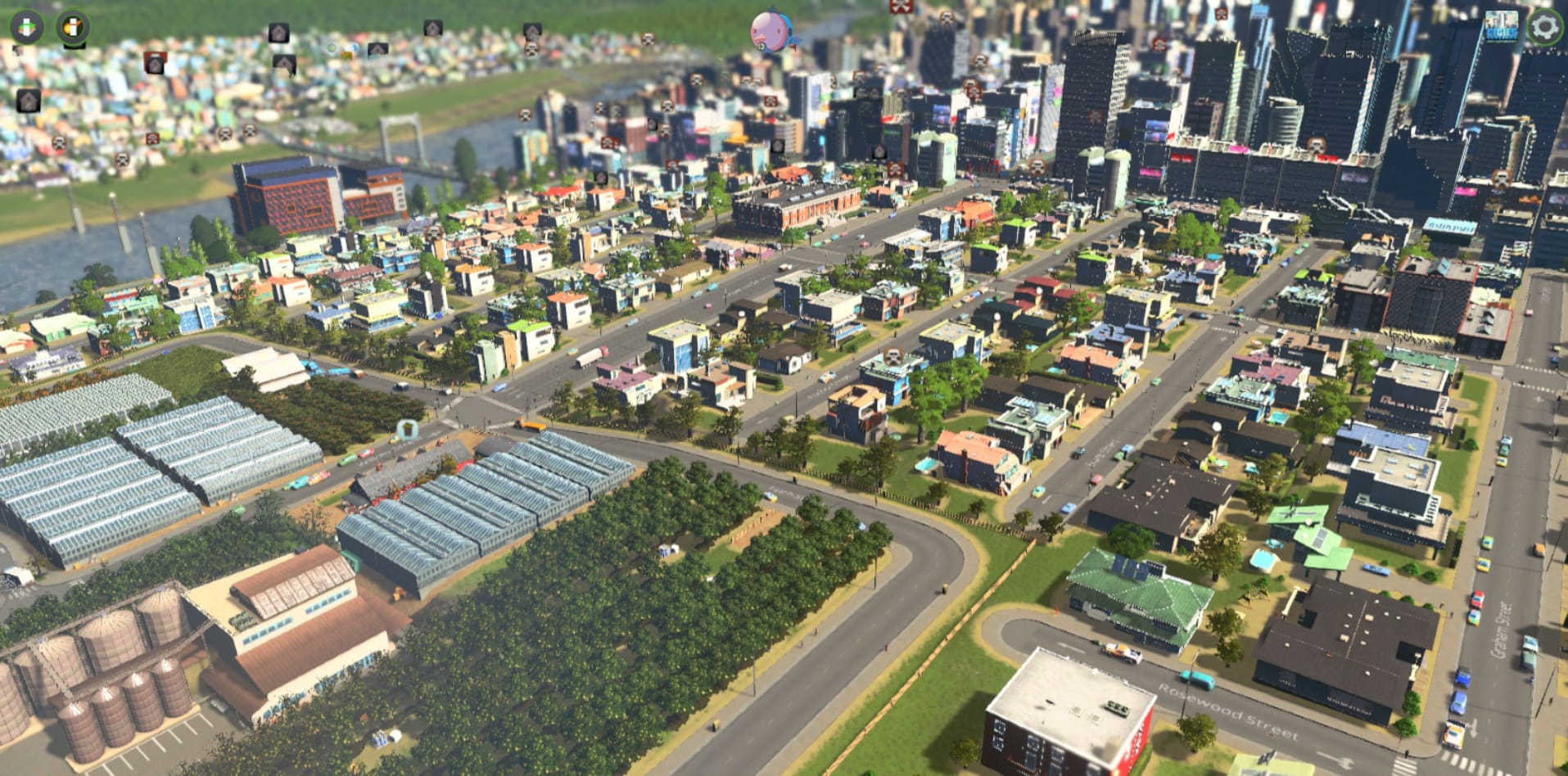
Topics we are addressing include questions on:
How are city builder video games operating?
- How do the games address issues of today such as climate change, social inequalities or infrastructure provision?
- Which aesthetics are used for the game and the cities represented themselves?
- How are city builder games representing different settings in time, geography and culture?
- How are game mechanics simulating political and economic systems, colonial realities and how do they influence player decisions?
- How are city builder games implementing moments of disruption, catastrophe, or failure?
How are city builder video games played?
- How are players influenced by game mechanics and aesthetics in their strategies for developing their cities and where are the limitations?
- What role do players hold in the game, what is their agency, and where are the limitations in regards to e.g. power, gender, race and class positions?
- How are imaginaries developed while gaming and experiences of the real materialities of cities connected?
- What understanding of the city do players bring to the game and how is the perception challenged while playing
- Which affects and emotions do players experience while gaming and how are these influencing approaches to the games?
- How do gender, race and class of the player effect approaches to the games?
Game Lab Team
Daniel Engel (University of Siegen)
Maren Feller (Goethe-University Frankfurt)
Denis Haag (Technical University of Darmstadt)
Christine Hieb (Technical University of Darmstadt)
Rembert Hüser (Goethe-University Frankfurt)
Christian Rosen (Technical University of Darmstadt)
Nikolay Smirnov (University of Kassel)
Friederike Weidner (Goethe-University Frankfurt)
Contact:
Christian Rosen: rosen@ifs.tu-darmstadt.de
About City Builders
Digital city building games give players the opportunity to become the creator of a settlement. Depending on the game, these can range from a small medieval village to a busy metropolis or a futuristic utopia. Much more than a mayor, president or dictator, they have the power to design and develop almost limitlessly (Bereitschaft, 2016). While often being labelled as “sandbox games”, many of them do not formulate explicit goals or winning conditions (Squire, 2008) but instead create an open-ended environment for players to experiment through creating, destroying and re-imagining. But the genre is changing, with game campaigns and set goals for players to achieve becoming more prevalent. Although in the initial versions of these simulators the metrics were particularly simple, they evolved over time. Today’s games offer a wide variety of settings, configurations, and actions that players can perform to develop their city. However, most of the games have a limiting factor as they are based on basic measurements: money or other resources (Martínez Euklidiadas, 2022).
The game mechanics promise to allow players to easily understand the rules and conditions of the games primarily through trial and error or what can be described as “a process of demystification” (Friedman 1999). While players are presented with a virtual “borderless playground” (Lauwaert 2007, 195), they are bound to the limits and assumptions of the game mechanics, including ideologies and biases of the game developers (Bereitschaft, 2016).
Scholars in game studies argue that both historical and contemporary urban spaces serve as inspiration for the aesthetics of the virtual cities (Bonner 2014; Vella and Krista 2018), meaning that game production includes a coherent set of rules from disciplines related to the built environment, particularly those concerning the human body and mind in spatial interactions (Álvarez and Duarte 2018)
Well known city builders include the “Sim City” and “Cities:Skylines” series among many others and can be categorised as non-serious games. They were originally designed primarily for entertainment and creativity – players build cities for fun, aesthetics, or competition. Serious City Builder Games on the other side, represent a smaller but growing segment and are used for education, simulation, or real-world decision-making. These games are designed to train professionals like planners or other groups, to test policies, or to visualize the impact of planning decisions, often based on real-world data (op de Beeke et al. 2024). Examples for this category include “EnerCities”, “Planpolitik”, “Urban Climate Architect”, “SmartCity/Edu.ecosim” or “Participatory Chinatown”. There have also been experiments with non-serious games as educational tools in the fields of urban planning (Khan & Zhao, 2021) and geography (Kim & Shin, 2015), for example by exploring ways to create sustainable cities in “Cities:Skylines” (Fernández & Ceacero-Moreno, 2021). However, the games have limitations as they simplify complex processes in many ways (Mukherjee, 2025).
Very few research has been conducted on the complex relationships between game mechanics and aesthetics on the one side and the urban imaginaries standing behind games and practices of players on the other – especially in the segment of non-serious commercial games and despite their partly complex and realistic designs and millions of people worldwide playing them. City Builder Game Lab aims at contributing to this gab in research.
Literature
Álvarez, R., & Duarte, F. (2018). Spatial design and placemaking: learning from video games. Space and Culture, 21(3), 208-232.
Bereitschaft, B. (2016). Gods of the city? Reflecting on city building games as an early introduction to urban systems. Journal of Geography, 115(2), 51-60.
Bereitschaft, B. (2022). Skylines of the mind: How city building games reflect urban imaginations and shape urban realities. In The Routledge companion to media and the city (pp. 77-88). Routledge.
Bereitschaft, B. (2023). Commercial city building games as pedagogical tools: what have we learned?. Journal of Geography in Higher Education, 47(2), 161-187.
Bonner, M. (2014). Analyzing the correlation of game worlds and built reality: Depiction, function and mediality of architecture and urban landscapes. Proceedings of DiGRA 2014.
Fernandez, P., & Ceacero-Moreno, M. (2021). Study of the training of environmentalists through gamification as a university course. Sustainability, 13(4), 2323.
Friedman, T. (1999). The semiotics of SimCity. First Monday 4 (4). http://www.firstmonday.org/ojs/index.php/fm/article/view/660/575
Khan, T.A., Zhao, X. (2021). Perceptions of Students for a Gamification Approach: Cities Skylines as a Pedagogical Tool in Urban Planning Education. In: Dennehy, D., Griva, A., Pouloudi, N., Dwivedi, Y.K., Pappas, I., Mäntymäki, M. (eds) Responsible AI and Analytics for an Ethical and Inclusive Digitized Society. I3E 2021. Lecture Notes in Computer Science(), vol 12896. Springer, Cham.
Kim, M., & Shin, J. (2015). The Pedagogical Benefits of SimCity in Urban Geography Education. Journal of Geography, 115(2), 39–50.
Lauwaert, M. (2007). Challenge everything? Construction play in Will Wright’s SimCity. Games and Culture 20 (3): 194–212.
Martínez Euklidiadas, M. (2022). Cities and Videogames: An Unexpectedly Constructive Relationship, Tomorrow City, <https://tomorrow.city/a/city-planning-games>
Mukherjee, S. (2025). Provincialising Cities: Skylines–re-appraising city-building games and minoritarian planning. The Journal of Architecture, 30(3), 550-568.
op de Beke, L., Joost R., & S. Werning (2024) Ecogames: An Introduction. Playful Perspectives on the Climate Crisis: 9.
Shi, H., Li, Y., Kong, Y., Ji, Y., Liu, Q., Huang, H., & Zhao, M. (2025). Cities in electronic games: how they present and impact real urban areas?. Journal of Asian Architecture and Building Engineering, 24(5), 4517-4531.
Squire, K. D. (2008). Video games and education: Designing learning systems for an interactive age. Educational technology, 17-26.
Vella, D. & Rutter Giappone, K. B. (2018). The City in Singleplayer Fantasy RolePlaying Games. In Proceedings of the 2018 DiGRA International 15 Conference: The Game Is the Message. http://www.digra.org/wp-content/uploads/digital-library/DIGRA_2018_paper_149.pdf