
by Carsten Ruhl
The main assumption of our Research Training Group is that buildings emerge from highly organized processes and that, once built, themselves are organizing processes well beyond the realm of architecture. But what about architecture that has never been realized physically? To answer this question, it might help to focus on a project that never became a reality but nevertheless had a strong impact on how Berlin was actually built as Germany’s new capital.
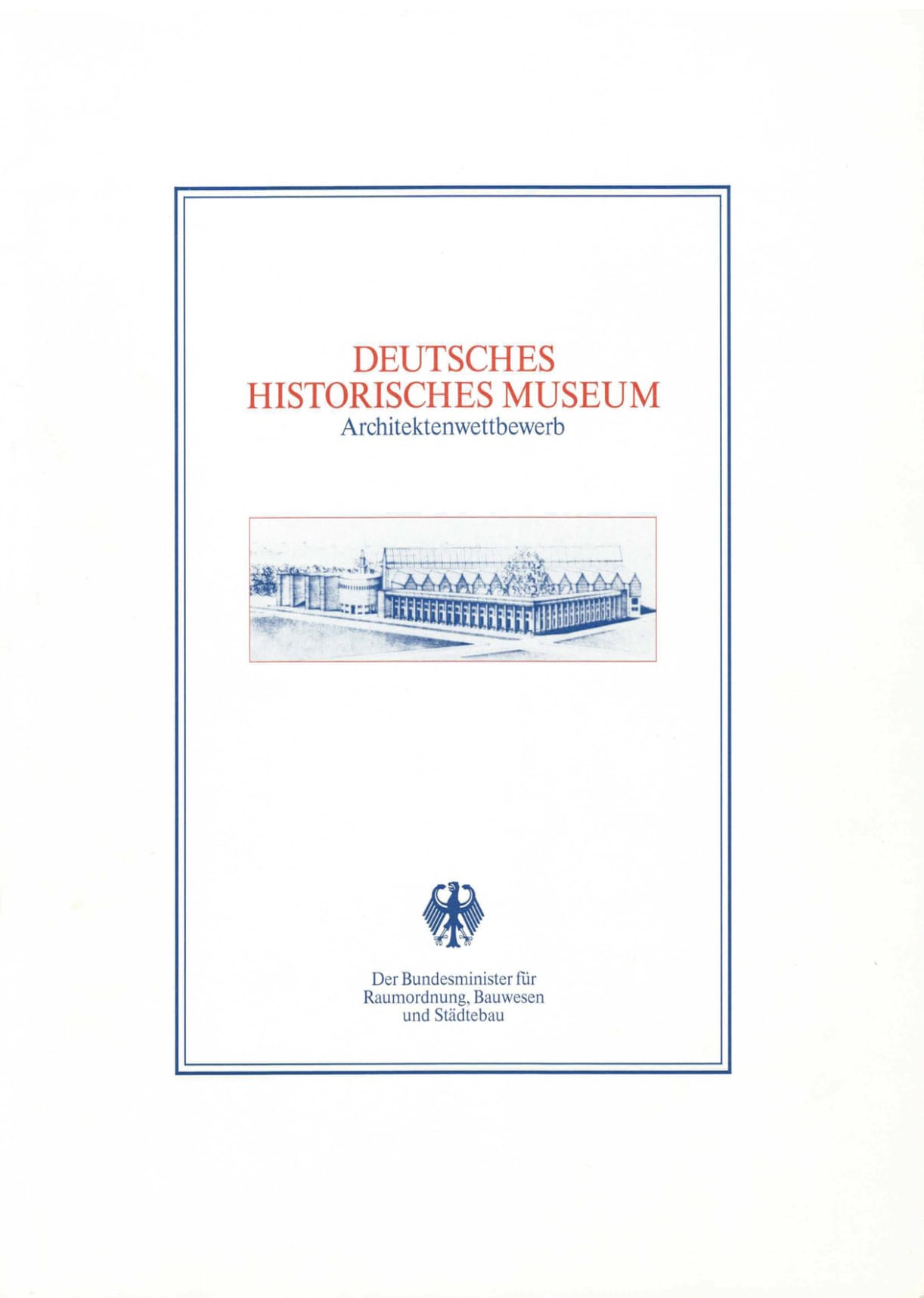
In 1988, the architectural office Aldo Rossi Associati has been awarded the first prize in the architectural competition for a new German Historical Museum (Fig.). The contribution was selected among over 200 entries. What at first sight might appear to be a quite simple process turned out to be a rather complex organizational undertaking. Years before architects could deliver designs for the envisioned museum, it were countless politicians, experts, critics and stakeholders who elaborated the conceptual foundation for this prestigious project. Given the fact that at the time Germany was still divided into West Germany (Federal Republic of Germany) and East Germany (German Democratic Republic) a new museum claiming to represent a shared national history triggered a long debate. Initially, it was less about architecture than about the meaning and purpose of such an institution. Some saw it as a legitimate act of identity-building – others feared a state-imposed history lesson. Symbolic political actions also fed the suspicion of an authoritarian reinterpretation of the recent past.
But how was this process organized?
In 1982, the conservative politician Helmut Kohl was appointed Chancellor of the Federal Republic of Germany. In his government declaration, Kohl, himself a trained historian, made the founding of the German Historical Museum his personal concern. He associated it with nothing less than a “national task of European significance”. In the same year, Richard von Weizsäcker, then governing mayor of Berlin, appointed a founding commission of four historians. This was followed three years later by an expert commission of another sixteen historians, art historians, and museologists. Its task was to elaborate ideas for the new museum and its permanent exhibition.
In spring 1986, the commission, exclusively consisting of male experts from the Federal Republic of Germany, presented a concept to the Berlin Senate, the Conference of Ministers of Culture and Minister-Presidents, the Bundestag Culture Committee, and the Federal Cabinet. Though the commission’s concept was supported by the government and a network of influential representatives from the cultural and political life of the Federal Republic of Germany, it soon became subject to many controversies. The government was suspected of using history as an instrument to build a new national narrative that played down Germany’s more recent past.
As a result of this massive critique, the commission launched another huge campaign. Around 3,000 representatives of diverse societal and political groups, institutions, as well as German universities were asked to comment on the museum project. Additionally, the commission organized three comprehensive hearings between 1986 and 1987 with even more representatives from economics, politics, academia, and culture. A final colloquium took place in Munich with the purpose of discussing architectural and museological issues. At around the same time, a further working group of another fifteen experts was formed to organize the architectural competition.
The institutionalization of German history was thus carried out with great organizational effort. However, what may appear to be the smooth running of organizational processes was in fact very soon caught up in the maelstrom of numerous conflicts. When the winning design was announced, the public debate expanded to include the competition. Various authors criticized the lack of transparency of the process, the generally questionable design task of a national museum of German history, and the plan for a monumental national museum in the immediate vicinity of the Reichstag building. Moreover, the awarded architectural design by Aldo Rossi Associati was associated with fascist monumentalism. The jury, chaired by the German architect Max Bächer, came under additional pressure due to three hearings held by the Senate with the participation of prominent critics.
However, the project was ultimately prevented by the course of history. With the fall of the Berlin Wall in 1989, a new museum building on the Spreebogen seemed unlikely. But this did not mean that plans were given up. Quite the opposite: instead of sticking to the heavily debated design, the German government decided to use an already existing building to host the new museum: the so called Zeughaus (arsenal) Unter den Linden. Of course, this was a decision no less problematic and disputable than the Spreebogen design. There was scarcely any other edifice in Berlin that better represented Prussia’s military strength and imperial political ambitions in the 18th century. Besides, it was not the first time the building had been used as a museum. Between 1953 and 1990 it hosted the GDR’s Museum of German History whose permanent exhibition was driven by Marx’s historical materialism and the idea of history as a sequence of class struggles. A new museum at this place and at this time with the purpose to present a shared and undivided national history could hardly be regarded as anything other than problematic revisionism.
Although the design by Aldo Rossi Associati never came into being it nevertheless had a huge impact on how Berlin was actually transformed into the new capital of Germany. Parts of the political elite were fascinated by the design’s historical allusions. It quite openly suggested that architectural form emerges either from concrete historical references or from a rather general idea of historical building types. As the architects indicated in their drawings, this included quite a number of heterogeneous pictorial references such as Schinkel’s Old Museum, Peter Behrens AEG Turbine Hall, Walter Gropius’ factory in Alfeld, Mies van der Rohe’s National Gallery, and Heinrich Tessenows Hellerau Festival Hall as well as building types such as the basilica, the nave, and the rotunda. In essence, the design envisioned a future architecture based on the imaginary reconstruction of what was actually absent at the construction site. The history that can be gleaned from the place itself is replaced here by the idea of timeless elemental forms as well as iconic buildings whose assumed origin is to be located, at best, in the collective pictorial memory of Berlin’s political and cultural elite.
© Minderbinder, CC BY-SA 4.0 https://creativecommons.org/licenses/by-sa/4.0, via Wikimedia Commons
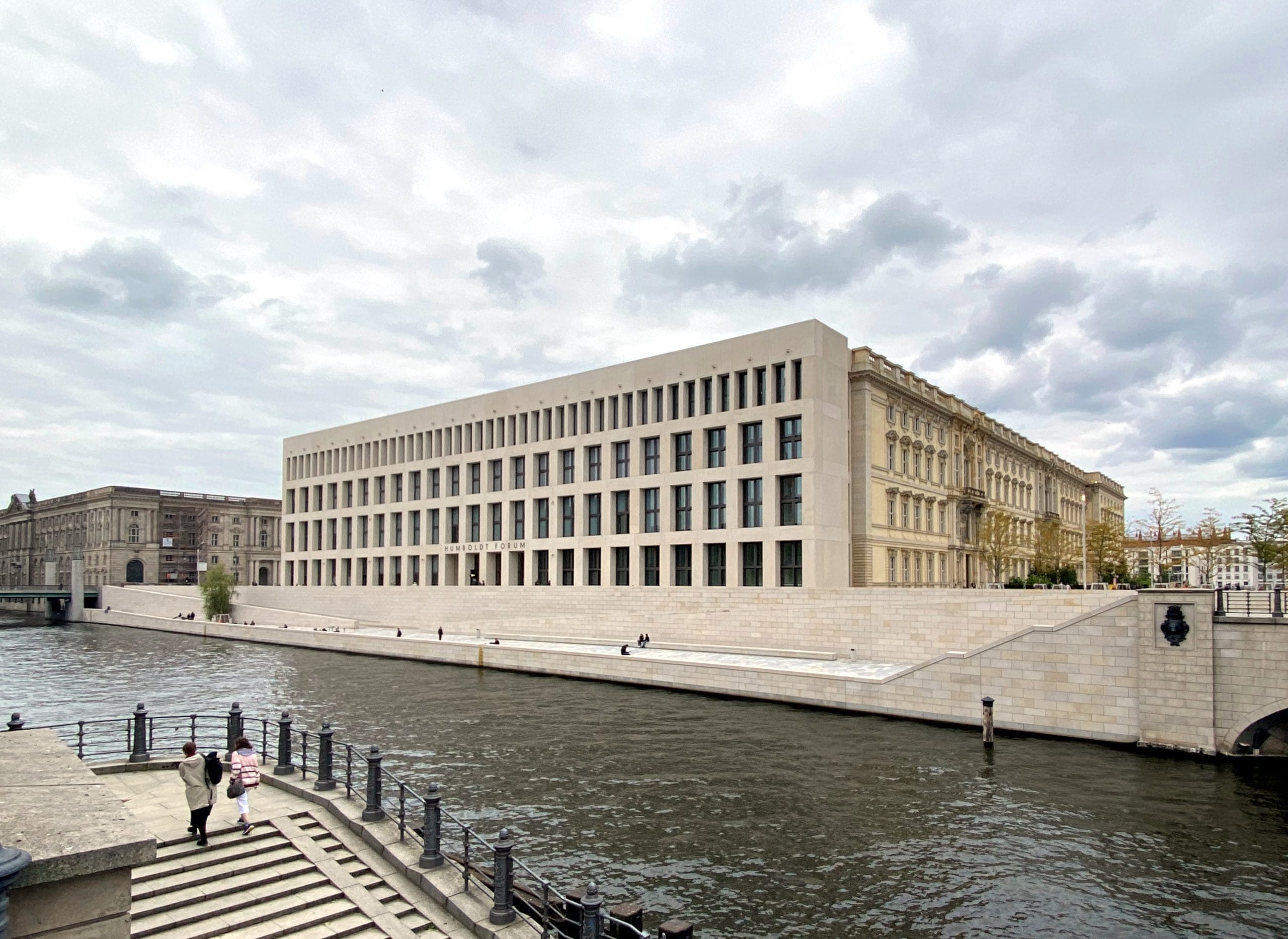
The most prominent project in this respect is certainly the Berlin Stadtschloss (Fig.) as it has been reconstructed in the years between 2013 and 2020. It suggests a politics of memory that creates the image of an undisturbed national history, leaving out disruptions, splits, and fragmentations. In tune with this general understanding of urban planning as the reorganization of history in space, the replica of the old Stadtschloss divests itself in situ before the eyes of the viewer as it never was, revealing an alleged timeless skeleton of window axes in strict sequence, of loggias, and columned halls. This emergence of the eternal from simulated history reaches its climax in the overall grid design for the façade on the Spree side. Thus, we are not ultimately faced merely with a design showing complete contempt for the present location and its history; the architect aims to demonstrate how something super-historical can be distilled from pseudo-historical monuments. So the vaunted reacquisition of history turns out to be negating history twice over. Thus, looking at the Berlin Stadtschloss, the modern city no longer needs to be rescued from itself, but from projections with little relation to reality that deny it any reality of its own. In this sense the Berlin Stadtschloss could be regarded as a utopian place legitimated by history but ignoring how the immediate past shaped the concrete place.
What can we learn from this case?
Well, first of all we could learn a lot about how architecture is organized by institutions and networks: ministries, cultural institutions, institutions of higher education, commissions, political parties, stakeholders and critics. They all took the competition for the new German Historical Museum as an opportunity for a rather general debate about cultural, historical and national identity building. Accordingly, the design has been interpreted by some as a critical reflection on history by using fragmented traditional forms and references, whereas others associated its architecture with revisionist thinking, historical ignorance, or even fascism.
Furthermore, it becomes clear that highly organized processes such as the project of the German Historical Museum do not guarantee control nor do they necessarily lead to buildings. On the other hand, long-lasting debates about projects of this importance have the potential to become dominant narratives in urban planning, as became clear in the case of the Berlin Stadtschloss. We could also speak of an architecture of discourse and powerful references with the potential to materialize in subsequent architectural and urban projects. This especially applies to the understanding of urban planning as a construction of monumental chimeras rather than coping with the actual situation of the construction site.
Literature:
Frederike Lausch/Phoebus Panigyrakis: Aldo Rossi in the Turmoil of „German Identity“. The German Historical Museum Competition of 1988, in: Histories of Postwar Architecture, 4(7), 2020, pp. 169–199, https://doi.org/10.6092/issn.2611-0075/11264
Paula Löwen-Pohle: Architektur als Aushandlungsprozess. Der Architekturwettbewerb zum Deutschen Historischen Museum von 1985 bis 1991, Master Thesis, Kunstgeschichtliches Institut, Goethe-Universität Frankfurt am Main, Frankfurt am Main 2021
Carsten Ruhl: Simulated History. The Berlin Schlossplatz as a utopian place, in: Sylvia Martin (ed.), Allora & Calzadilla (Kunstmuseen Krefeld/Haus Esters), Nürnberg 2009, pp. 40–46
Hendrik Tieben: Aldo Rossis Auseinandersetzung mit Geschichte, Erinnerung und Identität am Beispiel des Projekts des Deutschen Historischen Museums, Diss., Zürich/Braunschweig 2005